
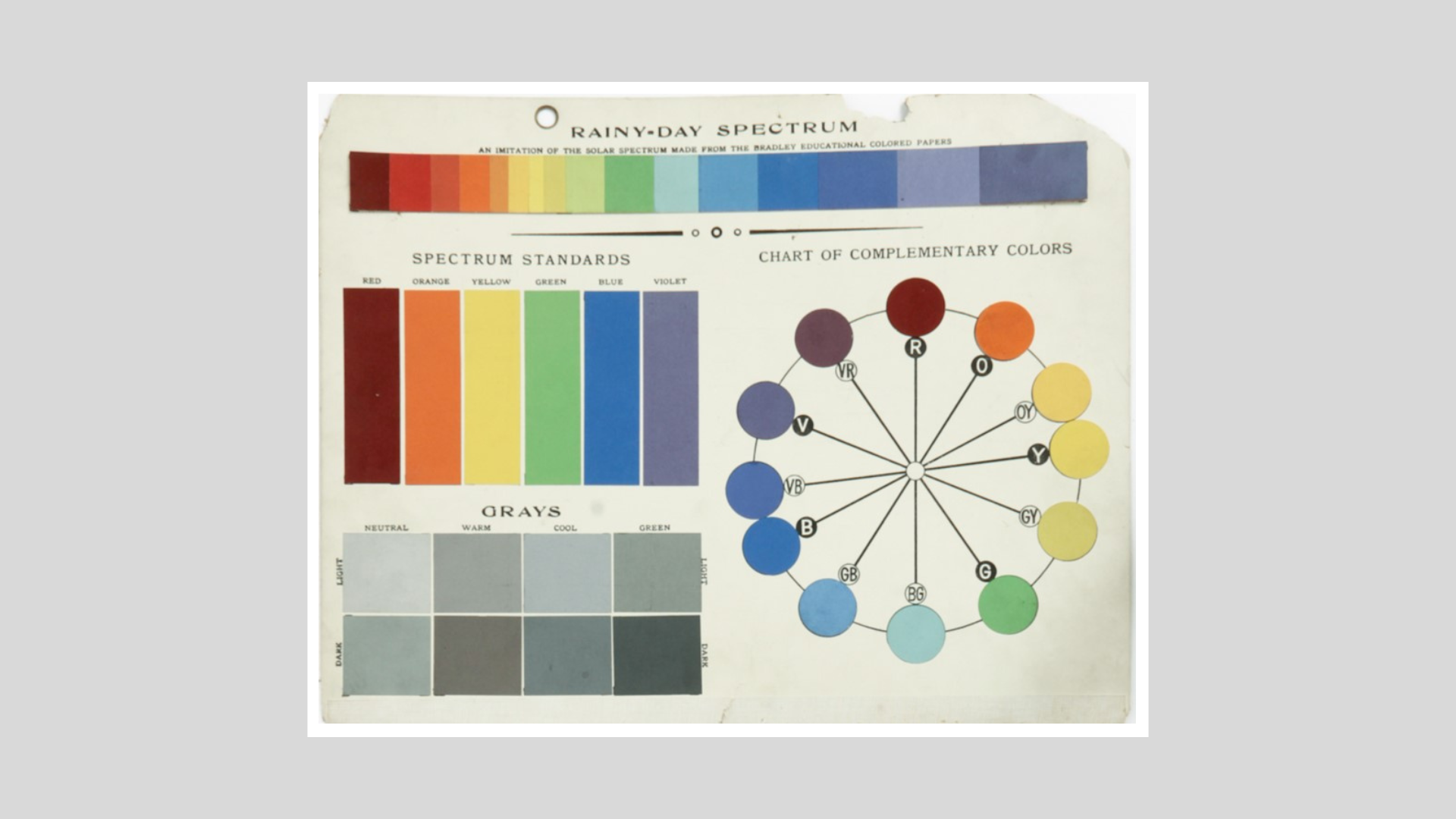
Milton Bradley (1836-1911), the man behind the Milton Bradley Company, is well-known for the board games produced by his company and the company's long-term success. However, Milton Bradley’s legacy also extends into a completely different sector wherein he brought together color theory, color standardization, creative activities, and early childhood education to become a pioneer not only in the emergence of kindergartens in America but art education with a focus on color for young children (Boston Evening Transcript, 1911; Oakes, 1975).
______
Born in 1836 in Vienna, Maine, Bradley moved to Springfield, Massachusetts, in 1856 where he worked as a mechanical draftsman. In 1859, Bradley went to Providence, Rhode Island, to learn lithography and, in 1860, he set up the first color lithography shop in Springfield, MA. In 1860, he created and then distributed a board game, The Checkered Game of Life which proved popular prompting Bradley to establish the Milton Bradley Company in the same year. Within a year, The Game of Life had sold 40,000 and Bradley achieved financial success (NMAH, 2024).
When the Civil War broke out in 1861, the company began to manufacture small-size games which soldiers could play in their spare time on the battlefield, prompting the trend for travel games. In 1920, the company acquired the game production division of McLoughlin Brothers, which had become the largest game manufacturer in the United States at the time. In 1984, the company was acquired by its rival Hasbro for $350million and the brand Milton Bradley Company continued to be used until 2009 (Jones, 1984).
Aside from his business interests, Bradley took an interest in both childhood education and color in the late 1860s. In 1869, Bradley published the first English edition of Edward Wiebe’s Paradise in Childhood, which advocated the ideas of German educator Friedrich Froebel who believed that children learn and thrive through creative activities. Thereafter, Bradley produced a range of kindergarten and early childhood creative educational items such as colored papers and colored pencils. Along with crayons and colored papers, Bradley developed and distributed color disks and wheels based on the fundamental work of the British scientist, James Clerk Maxwell. These invariably featured colors associated with traditional color theory – red, yellow, blue, orange, green and purple – and this color range become ubiquitous an highly familiar due to his widespread distribution.
Bradley’s interest in color, childhood education, and creative activities led him to publish Color in the School-Room (1890), Color in the Kindergarten (1893), Elementary Color (1895), The Color Primer (1897), and Water Colors in the Schoolroom (1900). He believed that colors should be based on the spectrum and not artists’ pigments but never-the-less tried to reconcile these (Snyder, 2005).
Bradley was interested in standardizing color for pragmatic purposes, and in this respect Smithsonian ornithologist Robert Ridgway adopted Bradley’s approach in his own work and “each made significant contributions to the standardization of colors (SI, 2017). Bradley helped to facilitate the entrance of art education into the public schools and his color-related products, many of which he patented, played a key role in this context (Snyder, 2005). In fact, Bradley received patents for Maxwell Disks for use with the Bradley color wheel (US Patent 492,604 (1893)
According to Snyder (2005), “The color theory advocated by Newton, Maxwell and Bradley was used primarily in the scientific production of art supplies and materials. The color theory taught in most classrooms [in America] was created by American artist Albert Munsell in 1905. The Munsell system was in direct competition with Bradley’s system, (which was) marketed primarily for grammar school and kindergarten teachers who were interested in incorporating color in their classrooms, while Munsell’s system was marketed for traditional art teachers” (Snyder, 2005, p72).
Bradley’s success in business enabled him to manufacture and distribute the materials required to explore color in childhood education. In this context, “he helped usher in a progressive education movement that had a focus on fine art through his production of papers, paints, crayons and the other materials needed to stock a kindergarten classroom” (Snyder, 2005, p73). In tandem with the experiential, media-based focus of Fröebel’s kindergarten system, and Bradley’s color materials, Bradley’s contribution to kindergarten activities and art education is significant in that he made educational materials affordable and easily accessible to educators (Oakes, 1975; Snyder, 2005, p73).
In his books, Bradley specifically mentions his key sources of information: Ogden Rood, George Field, William Von Bezold, Michel Chevreul and Owen Jones, as well as terms such as scales, keys and chords, groups of colors and tones that are also referred to as “dominant harmonies” and “perfected harmonies” generally in five tones. In discussing scales of colors, Bradley says, “each step is called a tone in that color scale and the full color may be called the key or key-tone in that scale” (Bradley, 1890, p22). He also discusses scales of tones with reference to varying hues and variations of lightness-darkness. In respect to Broken Color, Bradley noted, “Broken Colors or Broken Tints. — These words when properly used apply to colors mixed with gray, i. e., with both black and white” (Bradley, 1890, p20).
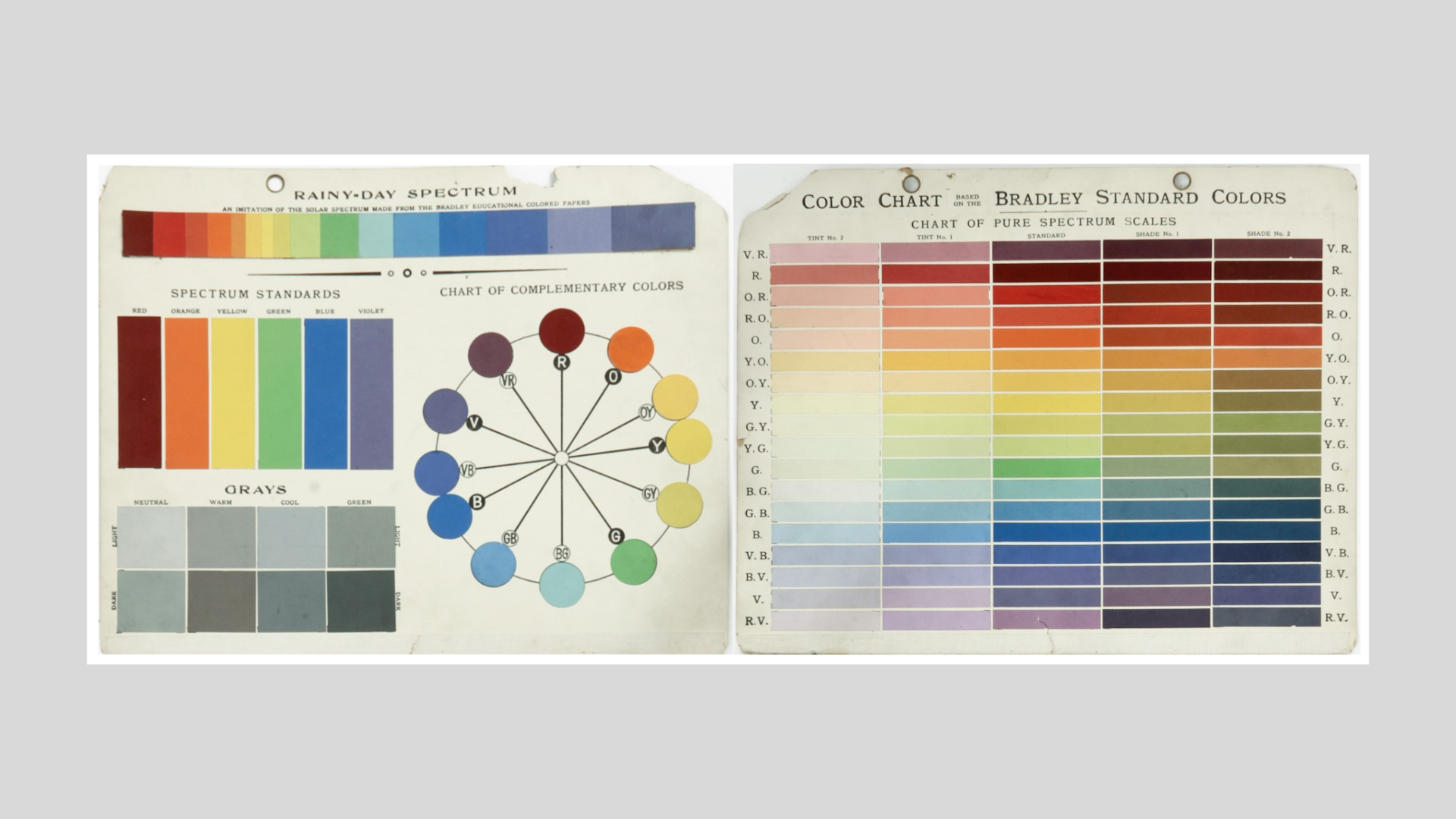
Bradley devised a syllabus of color that focused on teacher-guided color exploration, experimentation and discovery. To this end, Bradley published The Color Primer: Teachers’ Edition (1987) and Elementary Color (1895) and these featured a multitude of chapters that discussed color constructs common in color theory and education including those listed below, plus a series of color charts, color spinning disks, color wheels and colored papers. The use of colored papers rather than gouache or similar media was an innovative way of by passing the practice of mixing colors using pigments.
- Hue, Value, Luminosity
- Complementary Colors, Complementary Harmonies
- Dominant Harmony, Analogous Harmonies, Contrasted Harmony, Advanced Harmonies
- Simultaneous, Successive and Mixed Contrast
- Neutral Grays, The Study of Tones
- Broken Colors, Explanation of Broken Colors, An Exercise in Broken Colors
- Formulas for a Chart of Broken Spectrum Scales
In conclusion, Bradley’s success in business provided him with ample resources and this, coupled with his “willingness to work with teachers, [allowed him to] produce new art supplies and materials, such as the paper cutter, which would ultimately become an art room staple. Additionally, Bradley reproduced materials suggested by educators around the country and those designed by Fröebel himself” (Snyder, 2005, p73). It is thanks to Bradley that the use of color in the kindergarten is still in evidence today and, as Snyder notes, “The idea that this was not always the case is almost unbelievable, but the introduction of the kindergarten into the American public education system signaled the first time that color became widely available for students” (Snyder, 2005, p74). Bradley also made great use of the mail-order system, which had been introduced in America by the Montgomery Ward and Company in 1872 and subsequently made famous by Sears, Roebuck and Company in 1886 (Worthy, 1984). In doing so, Bradley’s books on color and educational color materials achieved a level of ubiquity that was shared by few color theorists and authors at the time.
References
Boston Evening Transcript (1911). Recent Deaths: Milton Bradley Was Leading Manufacturer of Games, Most of Which He Originated. Boston Evening Transcript, Wednesday May 31, p3. https://www.newspapers.com/article/boston-evening-transcript-milton-bradley/138031702/
Bradley, M. (1890). Color in the school-room : a manual for teachers. Springfield, MA: Milton Bradley Company. Accessed from https://archive.org/details/colorinschoolroo00brad/
Bradley, M. (1895). Elementary Color. Springfield, MA: Milton Bradley Company. https://archive.org/details/elementarycolor00brad/ https://library.si.edu/digital-library/book/elementarycolor00brad and https://www.gutenberg.org/files/40896/40896-h/40896-h.htm
Bradley, M. (1897). The Color Primer: Teachers’ Edition. Springfield, MA: Milton Bradley Company. Accessed from https://archive.org/details/colorprimer00brad/
Jones, A.S. (1984). Rival Gets Milton Bradley. New York Times, May 5, Section 1, p31. https://www.nytimes.com/1984/05/05/business/rival-gets-milton-bradley.html
National Inventors Hall of Fame (2024). Milton Bradley. https://www.invent.org/inductees/milton-bradley
National Museum of American History (2024). Color wheel, Milton Bradley. https://americanhistory.si.edu/collections/nmah_1184432
Oakes, C. R. (1975). Milton Bradley: An Historical Study Of His Educational Endeavors In The Context Of The Kindergarten Movement In America. Stockton, CA: University of the Pacific.
Seelye, K.Q. (2021). Reuben Klamer, Creator of The Game of Life, Dies at 99. New York Times, September 20, 2021, Section A, p20. https://www.nytimes.com/2021/09/20/business/reuben-klamer-dead.html
Smithsonian Institution (2017). Color in a new light: Matching color. [Exhibition documentation, May 2017]. https://library.si.edu/exhibition/color-in-a-new-light/matching
Snyder, J.L. (2005) A Critical Examination of Milton Bradley's Contributions to Kindergarten and Art Education in the Context of His Time [PhD dissertation]. Florida State University. https://diginole.lib.fsu.edu/islandora/object/fsu%3A168501
University of Toronto Scientific Instruments Collection (2013). Standard Color Chart, Milton Bradley, 1895. https://utsic.utoronto.ca/wpm_instrument/standard-color-chart/
Worthy, J.C. (1984). Shaping an American Institution. Chicago: University of Illinois Press.
© Dr Zena O'Connor, July 4, 2024